
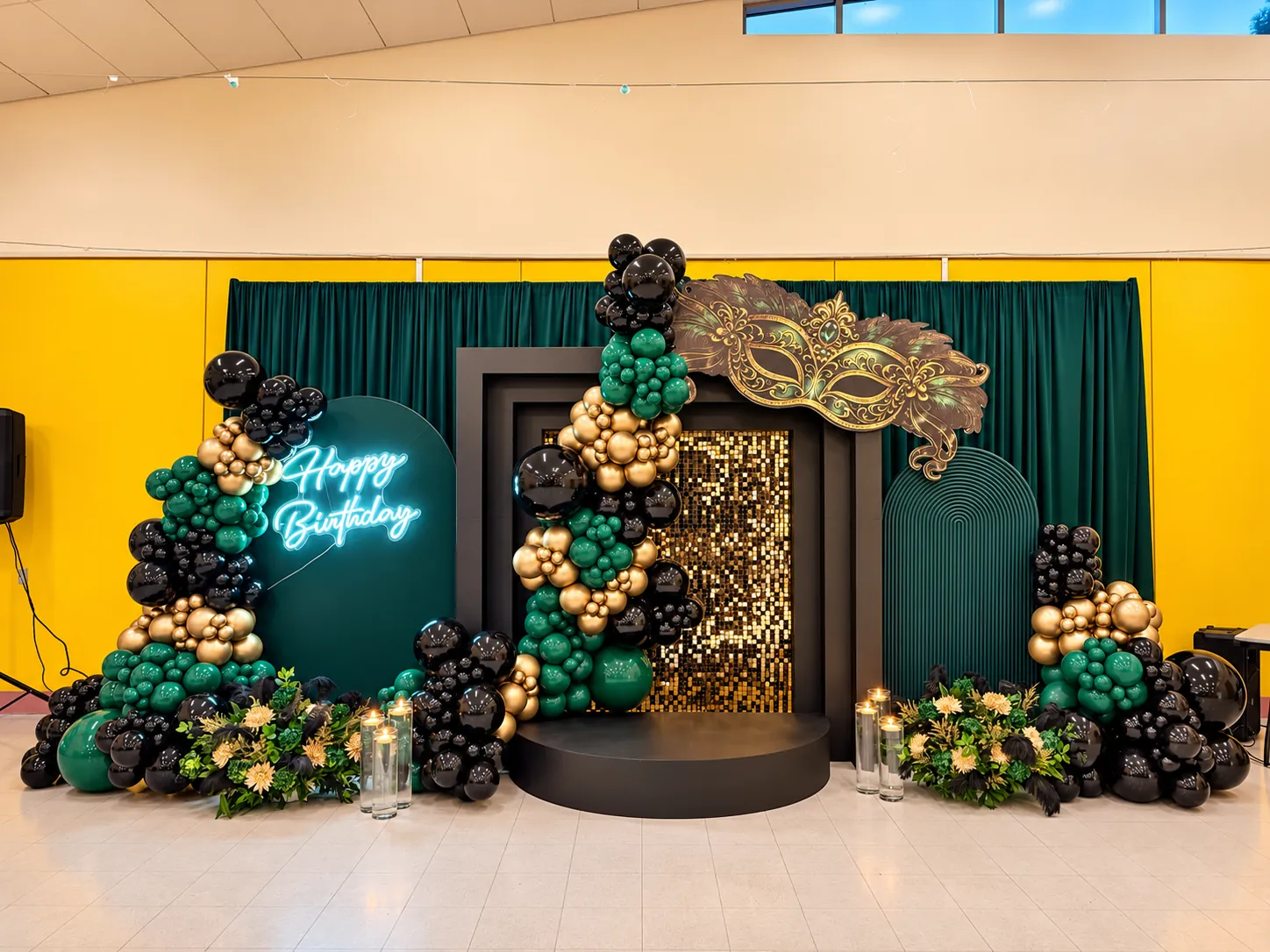
An event décor budget should tell you what your money is buying, what work still needs an owner, and which decisions are worth protecting. A collection of inspiration pictures cannot do that on its own. Beautiful installations combine objects, design time, transportation, setup, removal, and careful coordination with the venue. Leaving those services out of the first estimate makes an apparently affordable plan expensive later.
This guide is for hosts planning a birthday, graduation, shower, anniversary, or business celebration in the Los Angeles area. It also helps newer decorators ask better questions before quoting. The example numbers below are invented planning exercises, not HH Party Rentals prices or claims about average local costs. Use them to build a realistic scope, then request a written quote for your actual date, location, and design.
Start with the experience, not the shopping list
Write a one-sentence purpose for the celebration before selecting products. A useful example is: “We want a welcoming backyard birthday with one standout place for family photographs and enough clear space to mingle.” That sentence immediately makes some expenses more valuable than others. A strong photo backdrop supports the purpose. Three unrelated decorative corners may add cost without improving the experience.
Choose three priorities and rank them. Those might be a custom name panel, comfortable guest circulation, and a polished cake display. Decide what a successful photograph should show and what guests should notice when they arrive. This is a practical way to resolve disagreements later. When a new idea appears, ask whether it strengthens a priority or simply adds another object to transport, position, and remove.
Measure the room before choosing the design
The usable space is rarely the same as the advertised room size. Doors, serving tables, permanent furniture, steps, landscaping, and the photographer’s position all reduce the area available for an installation. Ask for photographs taken from several corners, a clear ceiling measurement, and the dimensions of the intended backdrop wall. Include the distance between the display and the nearest guest table.
For a backyard celebration, identify the route from the unloading point to the setup area. A narrow side gate may affect which props can enter. A slope or soft surface may change what is practical. Share these details before the quote is finalized. Paying for a design that physically fits the venue is better value than paying for a larger design that must be changed during setup.
Build the budget in separate layers
Separate the display itself from the work required to deliver it. Your worksheet should distinguish rentals, custom fabrication, printed graphics, balloons or florals, design services, delivery, setup, pickup, and any applicable charges. This does not mean every vendor must price the same way. It means you need to understand which parts are included in each proposal.
Keep venue and catering expenses on the same overall event worksheet, even if a different supplier handles them. Otherwise, décor can look affordable in isolation while the entire event exceeds the host’s spending limit. Record the maximum total first, subtract commitments already made, and only then assign a décor allowance. Leave a separate uncommitted amount for changes rather than quietly spending the whole balance on the initial concept.
Use an illustrative allocation to test priorities
Imagine a host has assigned $2,000 to décor and related services. A planning exercise might reserve $800 for a focal installation, $300 for complementary rentals, $200 for custom printing, $400 for transport and labor, and $300 as an uncommitted buffer. These figures are simply a way to test a plan; your vendor’s actual scope may require a very different allocation.
The important question is what happens when one line changes. If a custom structure adds $250, identify the tradeoff immediately. Could an existing rental replace it? Could a second display be removed? Would moving the installation indoors reduce another complication? Budgeting becomes useful when it makes these choices visible. A total without categories hides the decisions until an invoice arrives.
Compare complete proposals instead of headline prices
A backdrop advertised at one price may be an item-only rental. Another proposal may include styling, delivery, assembly, and collection. Comparing those totals without normalizing the scope gives the wrong answer. Ask each supplier what arrives, who installs it, when it must be returned, and what happens if the event schedule changes.
Create a comparison sheet with one row for each service rather than one row for each vendor’s grand total. Mark items as included, excluded, or awaiting clarification. Also compare dimensions, quantities, material choices, and customization limits. A smaller but fully serviced installation may be a better fit than a larger item-only package. The best proposal is the one that meets your needs with clear responsibilities, not necessarily the one with the lowest first number.
Put the strongest visual investment in one place
A cohesive focal area can carry the theme across many photographs. Start with a backdrop, a clear message or name, and a considered arrangement around it. Then use a small number of repeated colors or graphic details elsewhere. This often feels more intentional than distributing a limited budget across every wall, table, and doorway.
Think about the camera frame rather than counting decorations. A display can appear crowded when several strong elements compete at the same height. It can also look unfinished when everything sits at floor level. Ask the designer how the arrangement balances height, empty space, and the guest’s position. Editing a design is not simply a cost-cutting exercise; removing a competing element can make the remaining installation more effective.
Identify the costs created by customization
Custom work can involve artwork preparation, proof revisions, fabrication, finishing, and materials that cannot be reused for another client. A personal name, unusual shape, or exact color match may require a different production process from an existing rental. Ask which parts of the design are genuinely custom and which can be supplied from an established collection.
Protect custom spending by approving details carefully. Check spelling, event dates, dimensions, orientation, and the final approved artwork. Decide who has authority to approve the proof so several family members do not send conflicting changes. Ask when edits stop being practical and what additional revisions would cost. A clean approval process protects both the budget and the production schedule without sacrificing the personal touches that matter most.
Treat logistics as part of the design
The event may last four hours while the installation requires planning, packing, loading, driving, unloading, assembly, and a separate return trip. Access windows can affect how much crew time is required. A venue that allows setup only shortly before guests arrive may need a simpler design or more coordinated labor than a space available earlier.
Ask about parking, elevators, loading restrictions, stairs, and the deadline for removal. Confirm who communicates with the venue and who is present to approve placement. For Los Angeles events, provide the actual address and access instructions rather than relying on a neighborhood name. These practical details help a supplier quote the real job. They also prevent a decorative decision from creating an avoidable last-minute problem.
Create a change process before the final week
Make a short decision schedule with the supplier. Record when the theme, measurements, rental list, artwork, and access plan need approval. The exact deadlines depend on the job, so request them instead of assuming a universal booking timeline. A production calendar is more useful than repeated reminders to “book early” because it identifies what must happen next.
When a change is requested, write down its effect on cost, timing, and other elements. Adding a wider backdrop could affect balloon coverage, vehicle space, artwork size, and setup duration. Do not approve the visible item while forgetting the connected work. Keep one current version of the scope and ask for an updated written total whenever the plan changes materially. This reduces confusion for everyone involved.
Reduce spending without removing the personality
If the plan is too expensive, first adjust the number of decorated areas, the amount of custom fabrication, or the complexity of access and installation. Those choices often affect more than one budget category. Reusing a color palette across an existing prop and a printed sign can preserve a theme without commissioning every object from scratch.
Keep the features guests will actually interact with. A readable welcome sign, a meaningful backdrop message, and room to stand comfortably may matter more than small accessories that disappear in photographs. Ask the supplier for an alternative at a clear total budget rather than requesting an undefined discount. That invites a design solution. It also respects that removing work or changing materials is different from asking someone to provide the same work for less.
Close the event with a simple review
After the celebration, compare the approved plan with the actual result. Note whether setup access was accurate, whether guests used the focal area, and whether any custom pieces were difficult to transport or store. Keep photographs of successful angles and practical notes about what you would change. That information becomes valuable when planning another event.
For a decorator, track labor hours and unexpected work separately from the client’s visual feedback. A popular design may still be difficult to deliver efficiently. For a host, record the suppliers who communicated well and the decisions that made the day easier. A useful event budget is ultimately a record of priorities and responsibilities. When those are clear, the celebration is easier to enjoy and the design has a better chance of delivering what you intended.
Your next planning step
Create a one-page brief with your event date, venue, guest count, usable installation measurements, three priorities, and total décor allowance. Attach a few reference images with notes explaining what you like about each one. Then explore our event rentals and services and send an inquiry with that brief. You can also use our rent-or-buy guide to decide which pieces belong in a rental plan. Clear information helps turn an attractive idea into a proposal you can confidently compare and approve.
Your visual planning guide
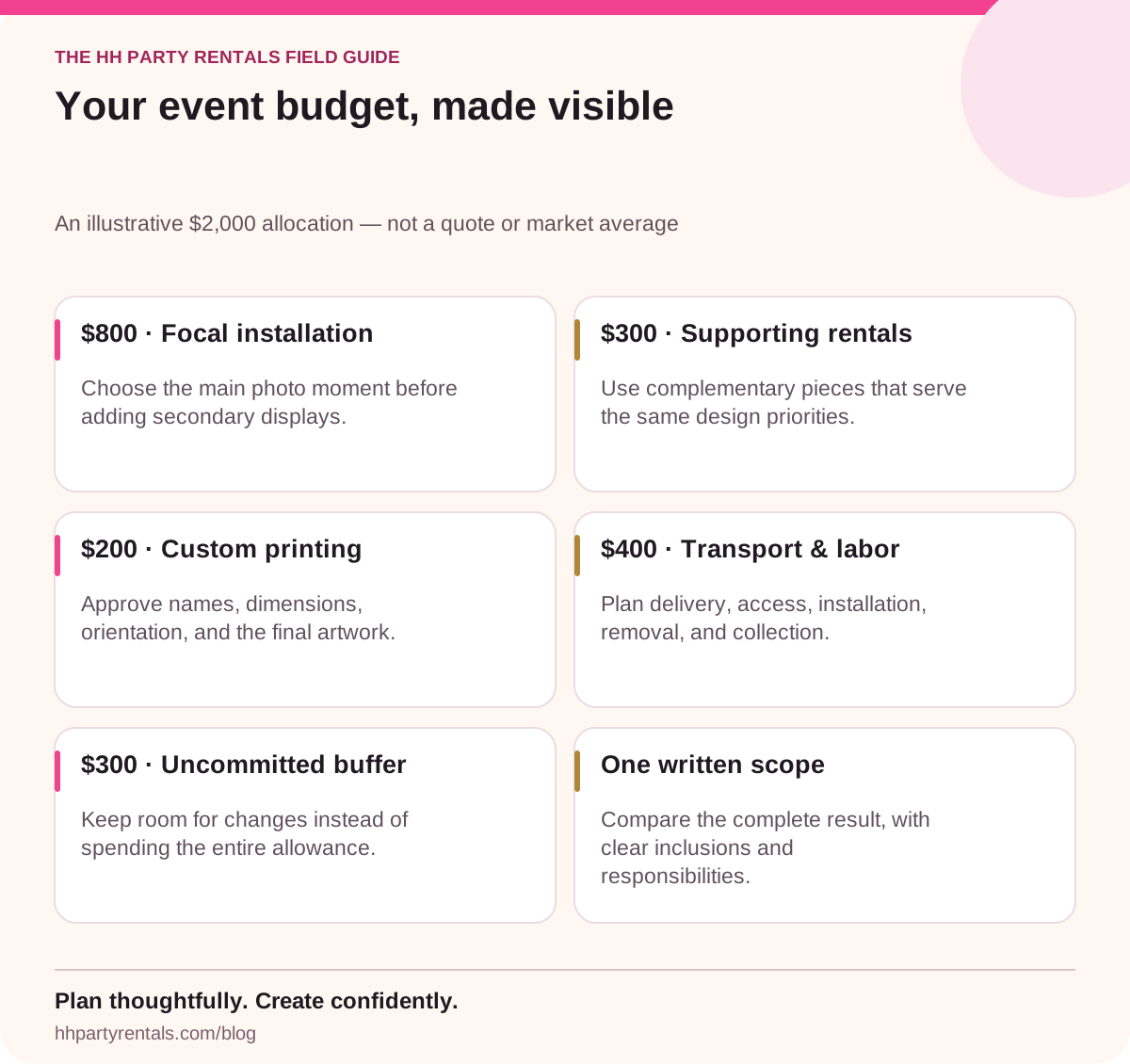
Read the infographic as text
- $800 · Focal installation
- Choose the main photo moment before adding secondary displays.
- $300 · Supporting rentals
- Use complementary pieces that serve the same design priorities.
- $200 · Custom printing
- Approve names, dimensions, orientation, and the final artwork.
- $400 · Transport & labor
- Plan delivery, access, installation, removal, and collection.
- $300 · Uncommitted buffer
- Keep room for changes instead of spending the entire allowance.
- One written scope
- Compare the complete result, with clear inclusions and responsibilities.
Bring your next idea to life
Share your date, venue, measurements, and priorities. We can help you explore the relevant rentals, printing, or learning options.
Talk to HH Party Rentals