
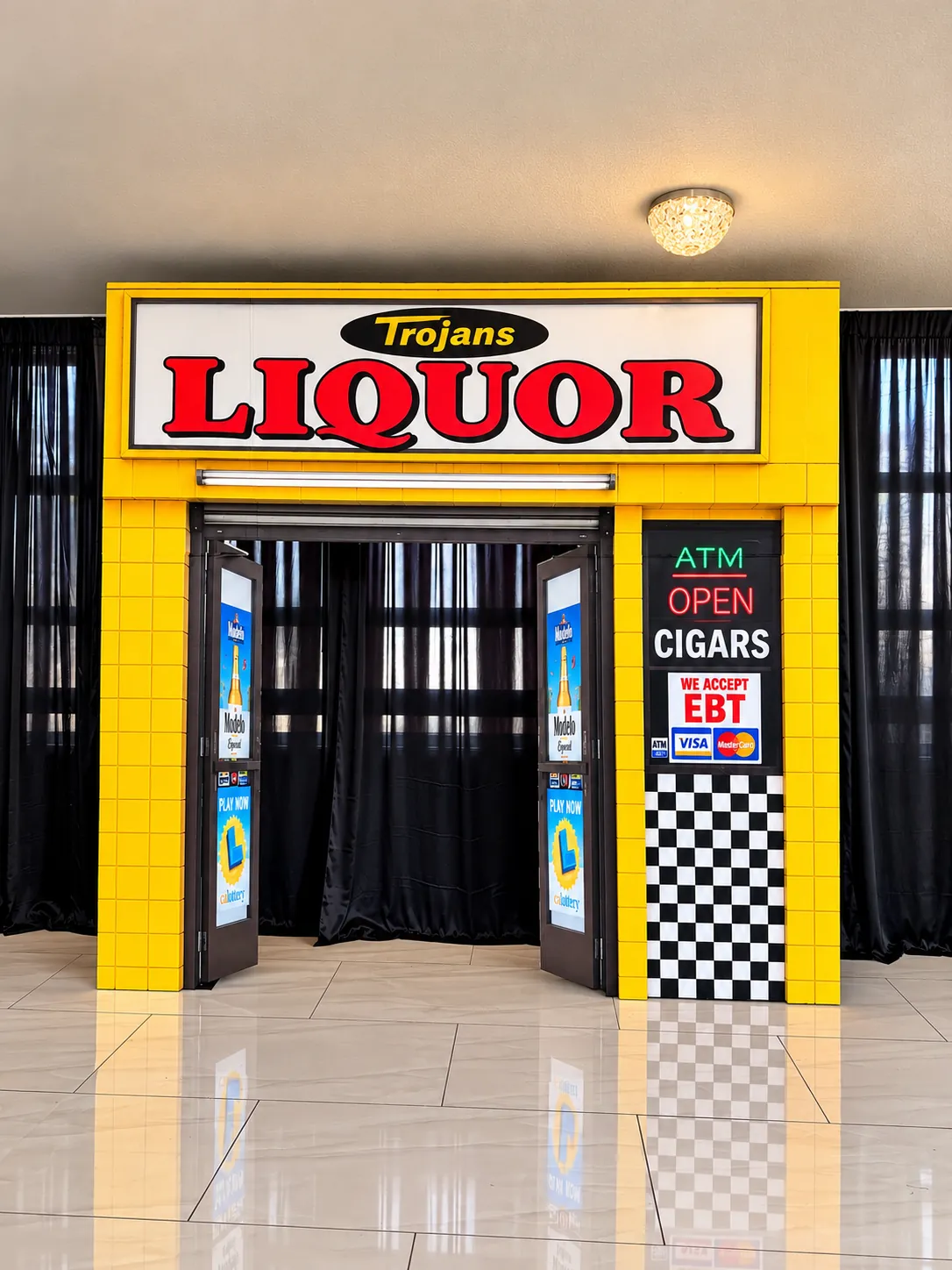
Starting a prop-building business can be exciting because the work is visible, creative, and closely connected to meaningful celebrations. A storefront entrance, themed backdrop, or custom display can become the center of an event. Turning that creative ability into a dependable service, however, requires more than learning how to cut a shape and post the result online.
This guide outlines a practical path from your first practice project to a repeatable small business. It focuses on planning, cost awareness, production habits, and customer communication. It does not promise a particular income or suggest that a class alone guarantees commercial success. The sample numbers are hypothetical. Use them to understand the decisions involved, then adapt the process to your skills, local requirements, available workspace, and the clients you actually want to serve.
Choose a focused first offer
Begin with a product you can describe, measure, produce, and transport reliably. “Custom props for every occasion” sounds flexible, but it creates an enormous range of materials, tools, design requirements, and customer expectations. A narrower first offer makes it easier to practice a complete process and quote it accurately.
For example, you might focus on flat event panels, small themed display pieces, or a defined backdrop package. Decide whether you are selling the finished item, renting it for an event, or providing a delivery-and-installation service. Those models create different costs and responsibilities. Write down what the customer receives, what customization is included, and what falls outside the offer. Clear boundaries help you learn without accepting a first job that demands an entirely unfamiliar production system.
Validate demand through real conversations
Look for a recurring customer problem rather than only a popular visual trend. Ask local decorators, photographers, hosts, and venue contacts what they struggle to source or deliver. Useful questions include whether transport is difficult, whether existing products are the wrong size, or whether turnaround and communication are unreliable. Listen for patterns before buying a large inventory.
Treat early interest as information rather than guaranteed sales. Someone liking a photograph is different from someone accepting a written scope and paying under agreed terms. Record the kinds of projects people request, their timing, and the practical constraints they mention. Then compare those requests with your ability to produce consistently. A useful first offer sits at the intersection of genuine demand and a process you can execute without depending on luck.
Learn the whole production sequence
Practice design, measurement, cutting, assembly, surface preparation, print application, finishing, packing, and setup as one connected workflow. A project that looks good on your worktable may still be awkward to carry through a doorway or unstable in its intended setting. Evaluate the finished item in the environment where it will actually be used.
Keep a practice log with materials, dimensions, time spent, failures, and improvements. Photograph details that need refinement rather than only the flattering angle. Use manufacturer instructions for the specific materials and tools you select, and seek qualified instruction for unfamiliar fabrication or support methods. Repeat a practice build before assuming you can deliver it commercially. Reliability comes from understanding where the process can fail and having a method for checking those points.
Plan your workspace around the work
Measure the space needed to store full materials, move around a work surface, and pack a finished piece. Consider ventilation, lighting, electrical needs, tool storage, and access for loading. The largest object you can assemble is not necessarily the largest object you can move out of the room. Plan the complete route from material delivery to event installation.
Avoid filling the workspace with inventory before you know your production pattern. Start with the materials and tools needed for the defined offer, then add capabilities when demand justifies them. Check the requirements that apply to your location and business activities through official local sources. Separate the cost of a creative hobby from the cost of operating a workspace that supports client deadlines, safe work practices, and consistent output.
Build a job-cost worksheet before setting prices
Record the direct materials used, printing, consumables, outsourced services, and labor for each project. Include preparation and finishing time, not just the main build. Then account for activities such as client communication, artwork revisions, packing, loading, delivery, installation, and collection when they are part of the service.
Suppose a practice job uses $120 in materials, $80 in printing, and $30 in consumables. If it also takes eight hours of work, pricing it only from the $230 of purchased items leaves labor and overhead unaccounted for. Assign a deliberate labor value and review the total. These figures are illustrative, not recommended prices. The point is to understand the complete job before copying a competitor’s number or choosing a price because it sounds appealing.
Separate markup, margin, and contribution
A markup is calculated against cost, while a margin is calculated against selling price. Confusing them can create unrealistic expectations. If an illustrative item costs $200 and sells for $300, the $100 difference is a fifty-percent markup on cost but about a thirty-three-percent margin on the selling price. That difference is not automatically take-home profit.
Your business still has expenses that may not be assigned directly to one item, such as workspace, software, equipment maintenance, and administration. The SBA’s break-even guidance uses fixed costs divided by the difference between unit selling price and variable cost to examine break-even volume. Use a consistent definition of costs and ask a qualified adviser for help if needed. A clear worksheet is more useful than an attractive percentage without context.
Define a quote that protects the production process
A useful quote identifies the deliverables, dimensions, quantity, customization, approved materials, service dates, and access assumptions. It should also explain the approval process and what happens when the client requests a change. Customers need to know what they are comparing, and you need a scope you can use while producing the order.
Keep inspiration images separate from final deliverables. A reference can communicate a mood without promising an exact recreation, material, or branded character. Discuss permissions for artwork and brand assets before using them. Establish one final approval contact and keep the approved specification in the job folder. For business terms, payment arrangements, insurance, and legal requirements, obtain advice appropriate to your situation instead of copying another supplier’s contract without understanding it.
Design transportation into the product
Measure your vehicle’s opening and usable interior, not just its advertised cargo capacity. Check the route through doors, gates, stairs, and elevators at the venue. A finished piece may require protective packaging, separate components, or a different delivery arrangement. Those decisions should be made during design rather than after the artwork is applied.
Build a packing checklist and photograph how reusable components fit in the vehicle. Label pieces so assembly does not depend entirely on memory. Include tools and approved supplies needed for the planned installation, but avoid assuming you can solve every site problem with an improvised fix. Confirm who provides access and where unloading is allowed. Transport is part of the service the client experiences, even when the promotional photograph shows only the finished display.
Build a portfolio with honest context
Photograph practice work and label it accurately. You can explain that a setup is a sample, a training project, or a styled demonstration without pretending it was a paid client event. Show a wide view, a closer detail, and enough context for someone to understand the scale. Consistent lighting and clear framing usually communicate workmanship better than excessive editing.
Ask permission before publishing identifiable client or guest images, and respect requests to keep personal details private. Describe the work you actually provided rather than taking credit for an entire event created by several suppliers. A trustworthy caption can identify the prop, print, or installation contribution clearly. Over time, a focused portfolio helps customers understand what you do well and reduces inquiries for services you do not offer.
Create a repeatable inquiry and booking workflow
Use the same initial questions for every inquiry: event date, venue, intended use, dimensions, inspiration, service needs, and budget. Save responses in one place instead of scattering them across messages and screenshots. A consistent intake process reveals missing information before you commit to a price or schedule.
Track the inquiry through stages such as awaiting measurements, quoted, awaiting approval, in production, ready for delivery, and completed. Keep deadlines visible and limit the number of simultaneous custom jobs to what your actual capacity supports. Good communication does not require promising immediate availability. It requires giving accurate information and doing what you said you would do. A smaller number of well-managed jobs can teach you more than a crowded calendar of loosely defined commitments.
Review each job before expanding
After delivery, compare the estimate with the actual materials, hours, travel, and corrections required. Ask which steps were repeatable and which depended on an exception. If a piece takes twice as long as expected, identify why before selling it again at the same price. Keep client feedback separate from the production review so both remain useful.
Use those records to decide whether to improve the process, change the offer, raise the price, or stop providing a difficult item. Expansion should solve an observed problem rather than satisfy the urge to own more equipment. Consider storage and maintenance before adding rental inventory. A business becomes more dependable when each completed job improves the next quotation and production plan, rather than disappearing into a camera roll and an unreviewed bank transaction.
Choose your next learning project deliberately
Pick one manageable build and document it from sketch to packed product. Calculate its complete cost, practice explaining the offer, and identify the limits of your current capability. If you want guided instruction, review our courses and the information for group classes or one-on-one training. Check the current course descriptions for the actual content, format, and availability before booking.
For the printing side of a project, use our print-ready backdrop guide. For inventory decisions, read the rent-or-buy guide. Building a sustainable creative service is a sequence of practical improvements: clearer offers, better records, reliable production, and honest communication. Those habits give your skills a stronger business foundation than any promise of instant success.
Your visual planning guide
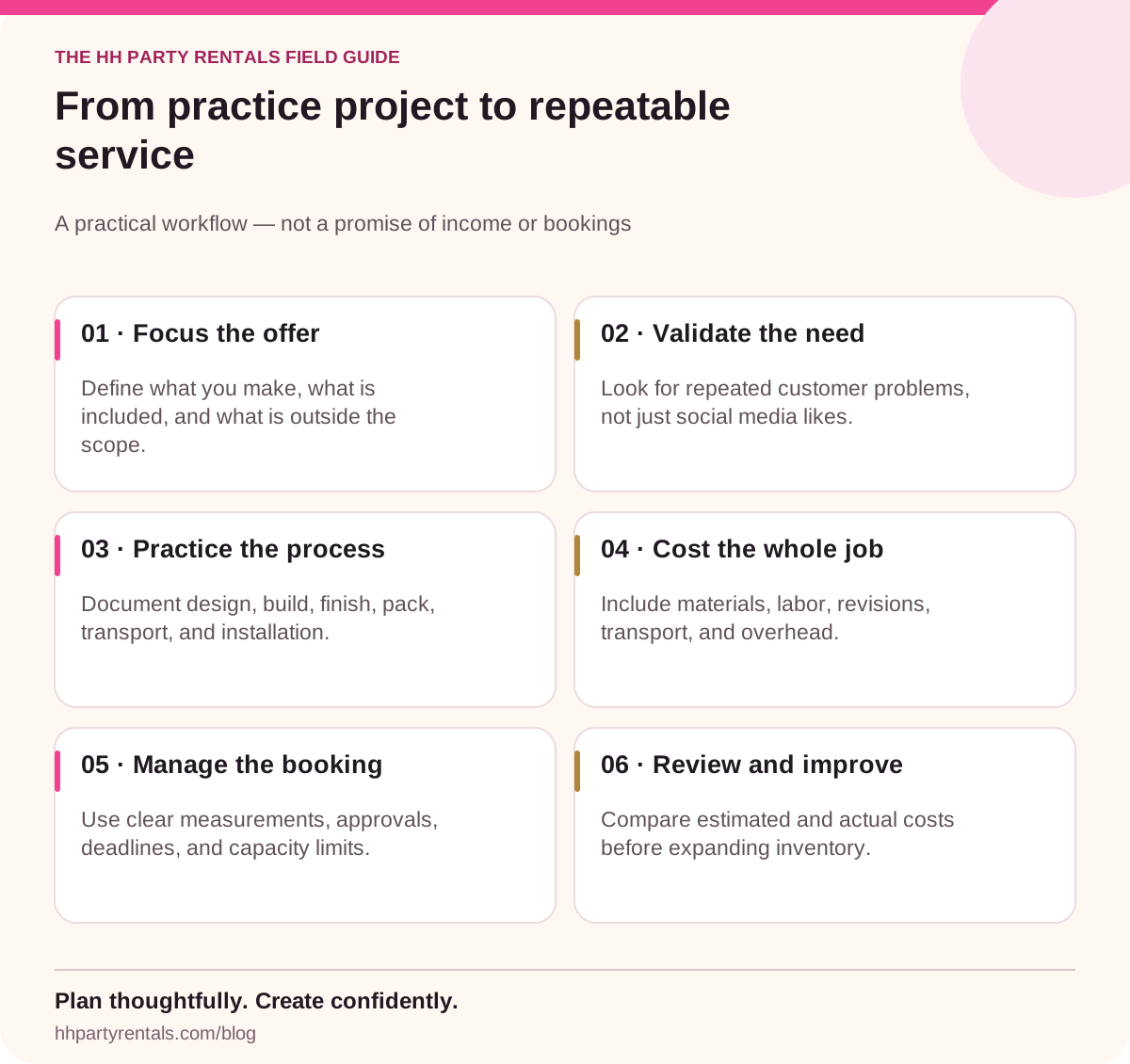
Read the infographic as text
- 01 · Focus the offer
- Define what you make, what is included, and what is outside the scope.
- 02 · Validate the need
- Look for repeated customer problems, not just social media likes.
- 03 · Practice the process
- Document design, build, finish, pack, transport, and installation.
- 04 · Cost the whole job
- Include materials, labor, revisions, transport, and overhead.
- 05 · Manage the booking
- Use clear measurements, approvals, deadlines, and capacity limits.
- 06 · Review and improve
- Compare estimated and actual costs before expanding inventory.
Bring your next idea to life
Share your date, venue, measurements, and priorities. We can help you explore the relevant rentals, printing, or learning options.
Talk to HH Party Rentals