
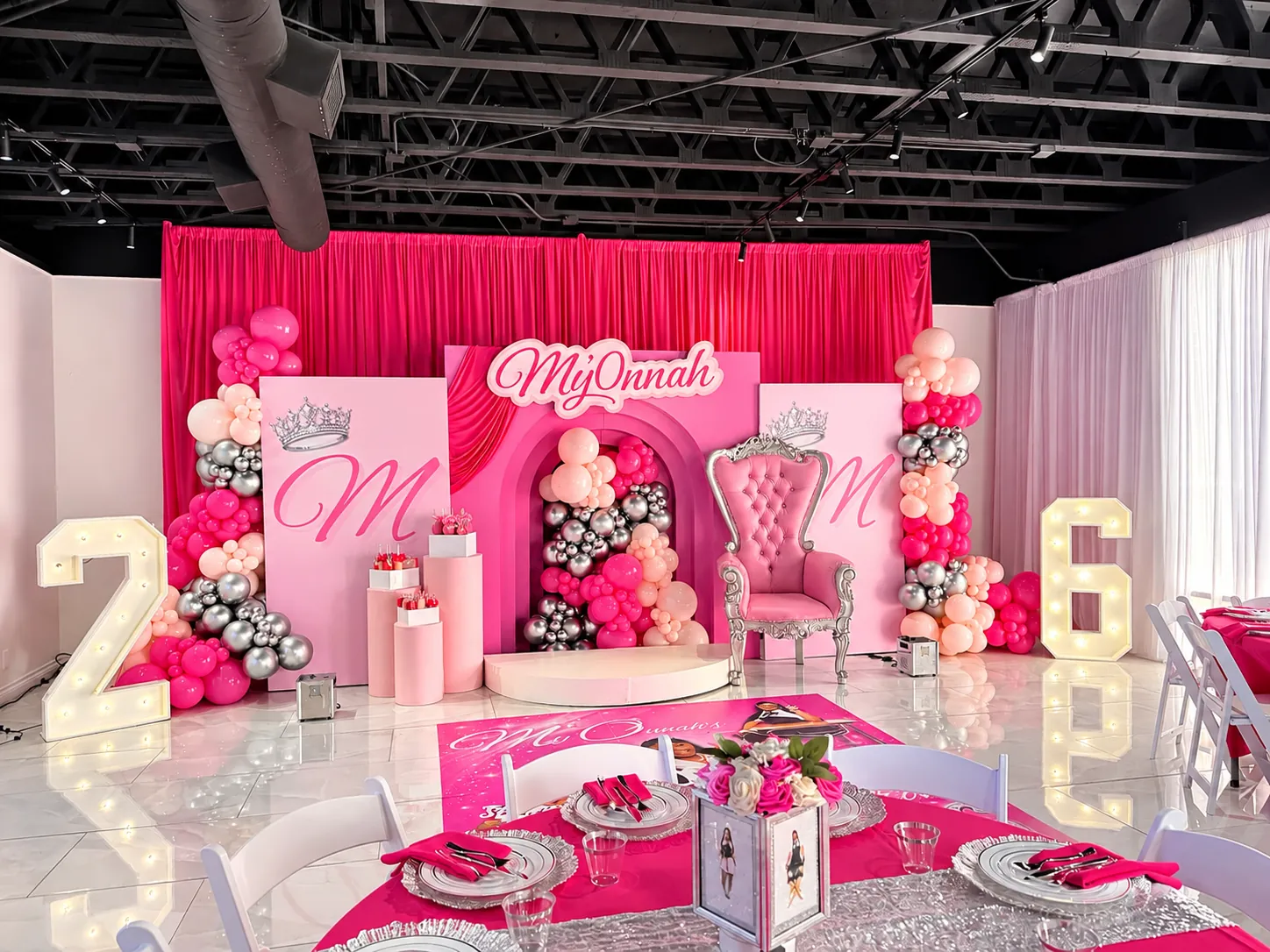
The decision to rent or buy event décor is not simply a comparison between a rental fee and a purchase price. Ownership also includes the work of selecting, transporting, storing, cleaning, maintaining, and eventually replacing an item. Renting may include some of those services, or it may leave them with the customer. The right answer depends on the full arrangement and how often the piece will genuinely be used.
This guide is for hosts planning a single celebration and for decorators deciding whether to build an inventory. It provides a practical comparison method, with hypothetical examples that illustrate the calculation rather than represent market rates. Whether you are considering a backdrop, display pedestal, platform, or themed prop, start with the job the item must perform. Then compare complete options that can actually deliver that result in your venue.
Define the use before comparing the options
Write down the item’s purpose, dimensions, appearance, and service requirements. A display intended to hold a lightweight sign has a different job from one intended to support equipment or people. Do not assume visually similar products are interchangeable. Confirm the intended use with the supplier and choose equipment appropriate to that purpose.
Also decide whether the appearance must be exact or merely coordinated with the theme. A host who needs a very specific personal design may choose a custom piece, while someone seeking a cohesive photo area may have several suitable rental options. Establish what is essential and what is flexible. Otherwise, the comparison can drift into evaluating a premium custom product against a much simpler rental that does not meet the same brief.
Compare delivered outcomes rather than isolated items
A purchase price may describe an unassembled item that arrives at your home. A rental proposal may describe a finished installation delivered to the venue. Those are not equivalent outcomes. Identify what additional work or purchases are required to make each option ready for guests, including supports, finishing, packaging, setup, and removal.
Ask whether the rental includes delivery, installation, pickup, or only collection from the supplier. For a purchased item, confirm lead time, assembly requirements, finished dimensions, and how it travels. Include any customization separately. The most useful comparison ends at the same point: a suitable, complete display installed at the event and dealt with afterward. Once both options describe that outcome, the financial and practical differences become much easier to assess.
Calculate the complete ownership cost
List the purchase price, shipping, necessary accessories, assembly labor, storage, cleaning, maintenance, and transport. If you are a decorator, also account for the time spent inspecting and preparing the item between events. A piece that can be used again is not automatically inexpensive to reuse. Each additional use may create real work and expense.
Avoid assigning a resale value unless you have a realistic basis for it. A personalized name panel or unusual themed structure may have a limited secondhand market. Even an item with resale potential may require cleaning, listing, negotiation, and collection arrangements. Treat resale as a separate uncertain outcome rather than subtracting an optimistic amount from the purchase price at the start. That keeps the ownership comparison grounded in costs you can actually anticipate.
Calculate the complete rental cost
Read the proposed rental terms and identify the item fee, service charges, applicable charges, and any responsibilities that remain with you. Ask about the rental period, collection and return windows, condition requirements, and what happens if timing changes. Understand the difference between a refundable amount held under stated conditions and a nonrefundable service charge.
The details matter because the rental period may not align neatly with the event hours. A pickup deadline can affect your schedule the next morning, and venue access may require a separate collection plan. Ask how issues are reported and how the supplier documents condition. Do not assume every provider uses the same policies. Clear rental information helps you compare options fairly and avoid assigning a lower cost to an arrangement that leaves important work unplanned.
Use a break-even example carefully
Imagine a decorator can buy an item for $600, spend $150 preparing it, and assign $150 to initial storage and handling arrangements. The resulting fixed ownership setup is $900. Suppose each use then costs $40 in cleaning and transport, while a comparable rental costs $190 for the same scope. The difference per use is $150, so $900 divided by $150 gives six uses as an illustrative cost-equivalence point.
That result depends entirely on the assumptions. It does not mean every item becomes profitable after six rentals or that future bookings are guaranteed. Damage, idle time, financing, changing demand, and different service scopes can alter the comparison. If the rental costs less than or equal to the ownership cost per use, there is no positive break-even point under that simple model. Use the calculation to expose assumptions, not to manufacture certainty.
Be honest about frequency of use
Count realistic booked or strongly supported uses rather than the number of occasions when an item could theoretically be useful. A neutral pedestal may fit several event styles, while a large prop built for one specific theme may be requested rarely. Frequency also depends on your clients, geography, storage access, and the services you actually offer.
For a one-time host, the likely use count may simply be one. In that case, ownership needs another reason, such as sentimental value, a home display purpose, or a known plan to reuse the piece. For a decorator, review past inquiries and completed jobs before buying. Separate personal enthusiasm for a design from evidence that customers want it. Inventory earns its place through suitable demand and manageable operating costs, not through how impressive it looks in a warehouse.
Treat storage as a physical constraint
Measure where the item will live, how it enters that space, and how other equipment remains accessible around it. Large pieces can consume usable space even when their floor footprint seems modest. Protective packaging, stacking limits, and the ability to retrieve one item without moving several others all affect the true storage burden.
Think about environmental conditions and the supplier’s care instructions. An item that needs careful storage may be a poor purchase for a host with only exposed outdoor space. A decorator should assess whether added inventory increases loading time or creates repeated handling damage. Storage is not free merely because you already have a room or garage. That space has limits, and using it for one object may prevent you from storing something more versatile or easier to maintain.
Include transport and access in the decision
Check vehicle openings, item weight, packaging, and the number of people required for handling. Confirm venue doors, gates, stairs, elevator access, and unloading arrangements. Buying a large item without a transport plan can turn a good purchase price into a recurring logistical problem. Renting from a supplier who handles delivery may solve that problem, but only if the service is included or clearly quoted.
Consider the end of the event as carefully as the beginning. After guests leave, someone must remove the item, pack it, load it, and take it to the right destination. The host may be tired or the venue may require a rapid exit. Assign those jobs explicitly. A realistic ownership or rental comparison includes the people and schedule needed to complete the whole process.
Evaluate customization and reuse separately
Personalization can make a display meaningful without requiring ownership of every component. A rented structure paired with a purchased custom print or removable design element may offer a useful middle path. Ask suppliers which components can be customized and what restrictions apply. Do not modify a rental item without permission or assume an adhesive can be removed without affecting its finish.
If buying, distinguish reusable structure from event-specific graphics. A neutral framework may suit future projects while the personalized artwork changes. Design those interfaces deliberately so replacement does not require rebuilding the whole object. Our print-ready backdrop guide explains why dimensions, substrate, and material choice need to agree. Reuse is most practical when it is designed into the piece rather than hoped for after the event.
Account for condition and visual consistency
A piece that looks attractive in a product photograph may arrive with a finish, scale, or assembly method different from what you expected. Ask for relevant specifications and current condition information. With a rental, clarify how normal condition is documented. With a purchase, understand the seller’s stated process for reporting problems before making assumptions about returns or repairs.
For repeat use, establish an inspection routine. Look for damage, loose components, finish wear, and missing parts according to the item’s intended use and care requirements. A decorator’s inventory should be ready to meet the appearance promised in a quote. If an item cannot be maintained consistently, its theoretical reuse value is less meaningful. Condition management is part of owning equipment and part of delivering a reliable rental service.
Use a hybrid plan when it fits the event
The most practical event may combine rented foundational pieces, purchased consumables, custom printing, and professional installation. You do not need to choose one ownership model for the entire celebration. Decide item by item according to reuse, storage, personal meaning, and service requirements. This can keep the visual result cohesive without placing every operational task on the host.
For example, a host might rent a backdrop structure and display pieces, purchase a personalized print, and arrange installation through an agreed service scope. A decorator might own a few versatile pieces and rent unusual items for occasional themes. These are possible strategies rather than universal recommendations. Compare actual availability and complete quotes. A hybrid plan works when the handoffs are clear and every component has an assigned supplier, installer, and removal owner.
Make the decision with a short worksheet
Create two columns labeled rent and buy. In each column, record the complete cost for the same event outcome, who transports the item, who installs it, where it goes afterward, and the realistic number of future uses. Add one final row for the biggest uncertainty. That could be storage, damage exposure, availability, or unconfirmed venue access.
Choose the option whose cost and responsibilities you can actually support. Browse our event rentals, review the portfolio for design ideas, and use the event décor budget guide to place the decision within the overall event. For new decorators, the prop-business guide provides a broader planning framework. The best choice is not ownership for its own sake or renting by habit. It is the arrangement that delivers the intended experience with clear costs, suitable equipment, and a manageable plan after the celebration.
Your visual planning guide
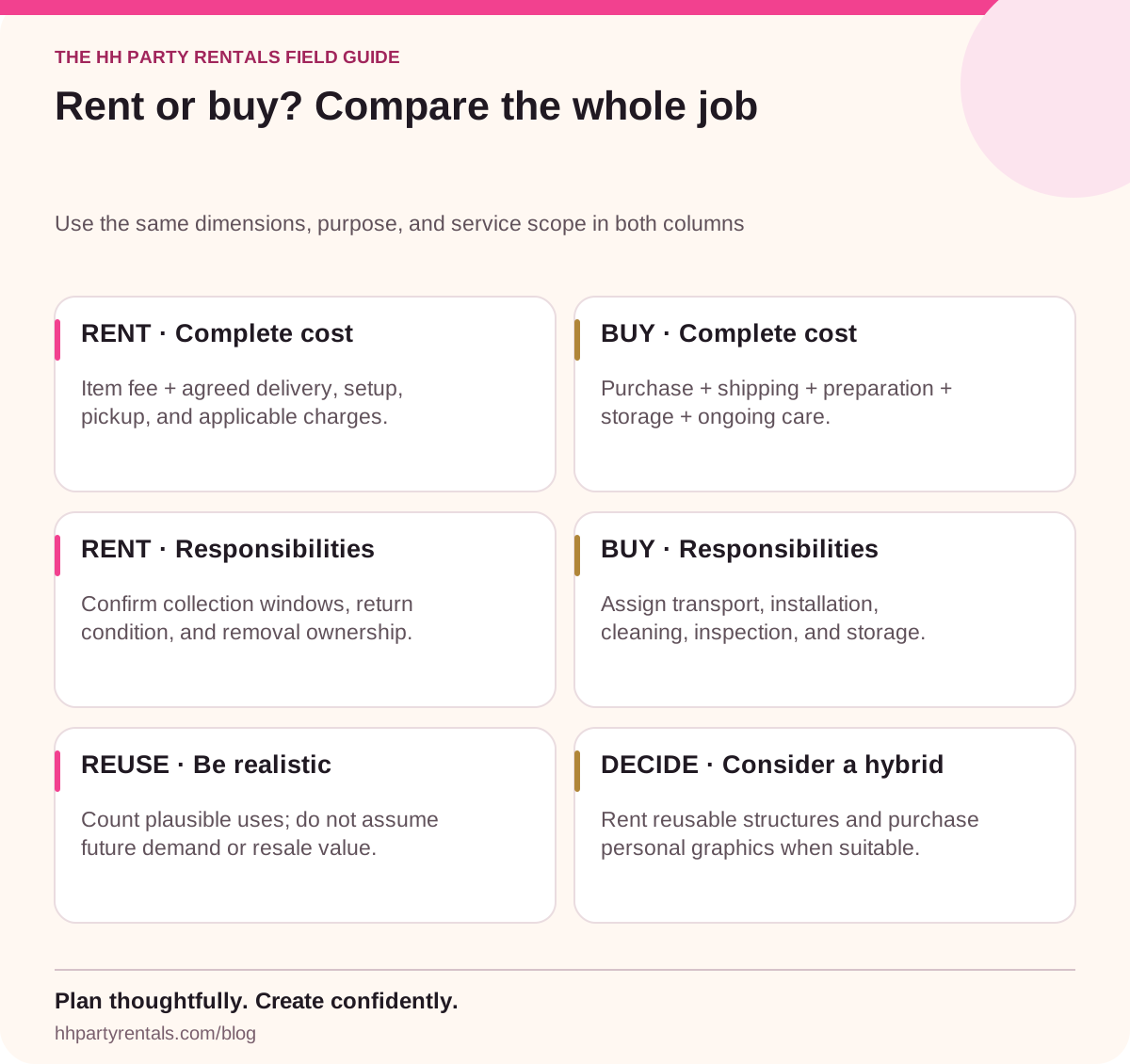
Read the infographic as text
- RENT · Complete cost
- Item fee + agreed delivery, setup, pickup, and applicable charges.
- BUY · Complete cost
- Purchase + shipping + preparation + storage + ongoing care.
- RENT · Responsibilities
- Confirm collection windows, return condition, and removal ownership.
- BUY · Responsibilities
- Assign transport, installation, cleaning, inspection, and storage.
- REUSE · Be realistic
- Count plausible uses; do not assume future demand or resale value.
- DECIDE · Consider a hybrid
- Rent reusable structures and purchase personal graphics when suitable.
Bring your next idea to life
Share your date, venue, measurements, and priorities. We can help you explore the relevant rentals, printing, or learning options.
Talk to HH Party Rentals